Here is a fun fact nobody puts on motivational posters: your skin is a pharmaceutical marvel. It covers roughly 2 square meters of your body, weighs about 4 kilograms, and — if you treat it right — can absorb therapeutic levels of testosterone continuously, day after day, without a needle, a pill, or a biweekly appointment with someone’s deltoid muscle.
The transdermal route to hormone delivery is not new. It is not trendy. It is, arguably, the most physiologically sensible way to replace testosterone that exists. And yet for decades it was overshadowed by IM injections and their charming cycle of supratherapeutic peaks and subtherapeutic troughs. That story, mercifully, is changing.
What “Transdermal” Actually Means
Let’s get the terminology straight, because it matters more than you’d think. “Transdermal” literally means “across the skin.” It describes any delivery route in which a drug crosses the skin’s barrier layers and enters the systemic circulation. This is distinct from “topical” in the strictest pharmacological sense — a topical effect stays local, a transdermal effect is systemic.
The skin’s primary barrier is the stratum corneum: roughly 15 to 20 layers of dead, flattened, keratin-packed cells sitting on top of the viable epidermis. It is the bouncer of your body. Most drugs can’t get past it. Testosterone can, particularly with the right formulation chemistry — more on that in Post 3.
Once through the stratum corneum, testosterone dissolves into the viable epidermis, diffuses through the dermis, and enters the rich capillary network lying just beneath the surface. From there, it travels directly into the systemic venous circulation and eventually reaches the androgen receptors waiting patiently throughout muscle, brain, bone, and other tissues.
No liver. No first pass. No metabolic shredding before the hormone even gets a chance to do anything.
The First-Pass Problem — And Why Skin Avoids It
Oral testosterone has a miserable history, and the liver is mostly to blame. When you swallow a drug, it gets absorbed through the gut wall, travels up the portal vein, and passes through the liver before ever reaching systemic circulation. The liver, doing exactly what it’s supposed to do, metabolizes a significant fraction of the drug on the first pass through. For testosterone, first-pass hepatic metabolism is so aggressive that oral preparations historically required supraphysiological doses just to achieve measurable blood levels — with the attendant hepatotoxicity and HDL suppression that 17-alpha-alkylated oral androgens reliably produced.
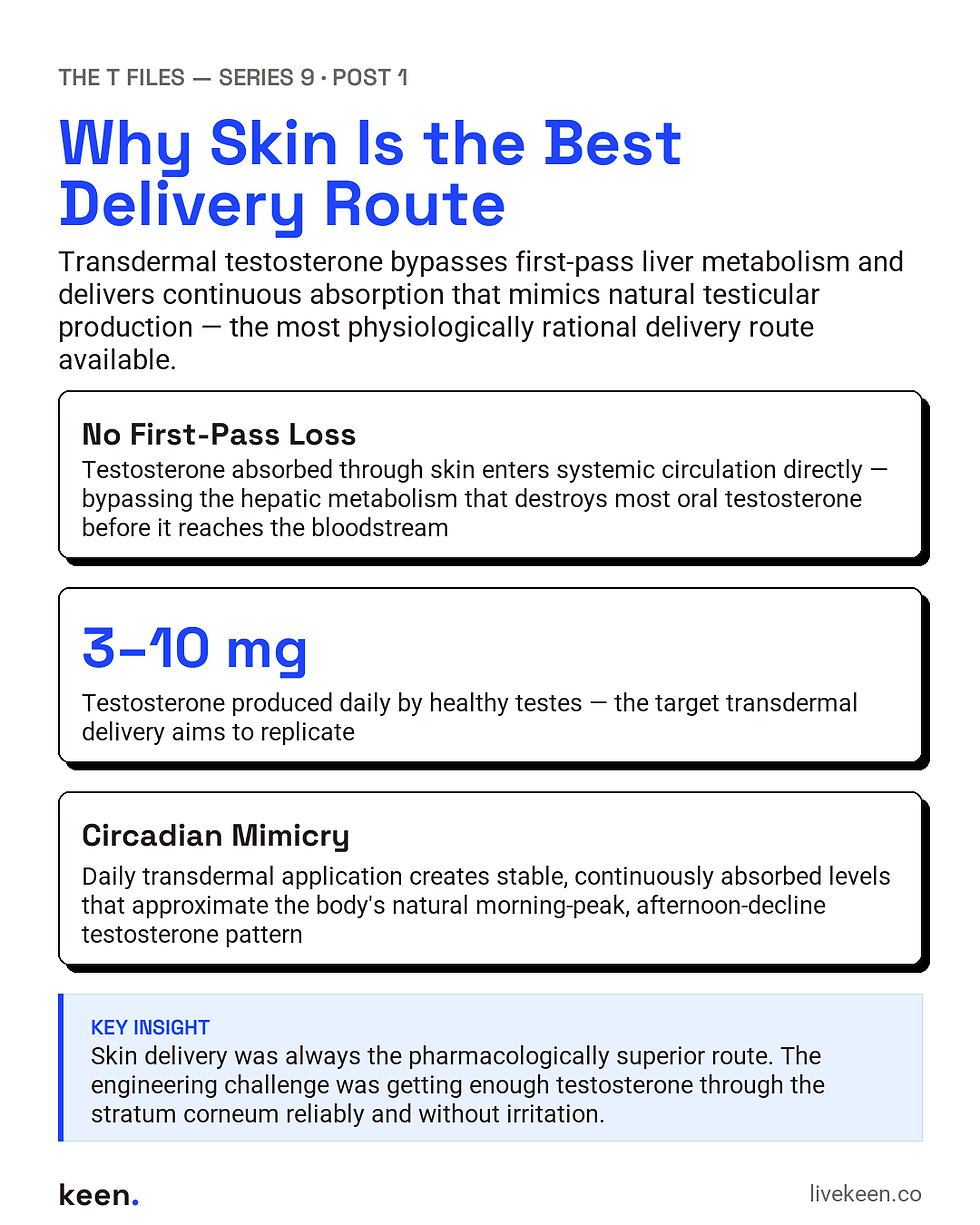
Transdermal delivery elegantly sidesteps this. Testosterone absorbed through the skin bypasses the liver entirely on its first pass into circulation, entering venous blood and reaching systemic distribution before hepatic exposure. Bioavailability is preserved. Liver-generated adverse effects are avoided. It is one of the cleaner pharmacological wins in endocrinology.
Mimicking What the Body Actually Does
Here is the deeper pharmacological argument for transdermal delivery: it actually resembles normal testicular function more closely than injections do.
The healthy testes produce between 3 and 10 mg of testosterone per day, releasing it in a pulsatile but relatively continuous pattern. Levels peak in the early morning — typically between 6 and 10 AM — and decline gradually through the day. Transdermal preparations, when applied daily, create a continuously absorbed, relatively stable blood level that mimics this pattern reasonably well, particularly when applied in the morning.
Compare this to intramuscular testosterone enanthate or cypionate, which produce supratherapeutic peaks within the first 36 to 48 hours post-injection and then fall toward subtherapeutic levels by week two. Research published by Shoskes, Wilson, and Spinner (2016, Translational Andrology and Urology) documented mean peak concentrations exceeding 1,200 ng/dL within 24 to 48 hours of a 100 mg dose of testosterone enanthate — well above the 400–700 ng/dL therapeutic target — before declining steeply toward the lower limit of normal by day 14. The clinical consequences: mood swings, energy crashes, libido fluctuations. None of this is subtle to the person experiencing it.
Daily transdermal dosing eliminates those peaks and valleys. AndroGel 1% at 50 mg/day, for instance, produced a Cmax of approximately 560 ng/dL at 22 hours and a Cmin of around 360 ng/dL — a much flatter, more physiological pharmacokinetic profile.
The Scrotal Advantage (A Brief Detour)
One anatomical oddity worth noting: scrotal skin absorbs testosterone at dramatically higher rates than non-scrotal skin — roughly 5 to 10 times better, based on early transdermal patch studies from the 1980s. The scrotal skin is exceptionally thin, highly vascularized, and lacks the thick stratum corneum found elsewhere on the body. The first commercially successful transdermal testosterone patches were scrotal (Testoderm, 1993), applied to shaved scrotum and delivering impressive bioavailability.
The obvious problem: shaving the scrotum twice weekly is, by nearly all accounts, not a habit men maintain enthusiastically. Scrotal patches fell out of widespread use, replaced by non-scrotal patches and gels. But the underlying biology is real — the scrotal site works pharmacologically for a clear anatomical reason.
The Non-Scrotal Revolution: Patches and Gels
Non-scrotal transdermal patches (Androderm, approved in 1995) worked by incorporating chemical permeation enhancers into the patch formulation to compensate for the lower absorption rate of trunk and limb skin. They achieved reasonable pharmacokinetic profiles — testosterone peaks around 8.2 hours after application, half-life of approximately 1.3 hours — but brought their own liabilities: application site reactions (pruritus, blistering) in roughly 48% of users in combined clinical trial data, per Shoskes et al. 2016.
Gels (starting with AndroGel in 2000, Testim in 2002, and multiple generics since) became the dominant transdermal format for exactly the reason that patches failed — they were far better tolerated on the skin. Skin irritation rates dropped dramatically. Absorption was continuous throughout the day. Multiple application sites were available.
But gels introduced a new problem entirely, one serious enough to earn an FDA Boxed Warning. That is the subject of Post 2.
Why This Route Was Always the Right Answer
A 1990 consensus review by WHO, NIH, and FDA researchers concluded that the transdermal route represented the most physiologically rational approach to testosterone replacement, citing continuous delivery, avoided first-pass hepatic metabolism, and stable blood levels. This was the scientific community effectively declaring victory in principle while the engineering problems of exactly how to get enough drug through the skin hadn’t quite been solved yet.
Thirty-five years later, the engineering has caught up to the biology.
Next up: Gels solved the skin tolerance problem that patches created. But they created a different problem — one that has hurt children, alarmed the FDA, and made a lot of men with young families extremely cautious about testosterone therapy. Post 2: The Problem With Gel Transfer.