We have now covered five posts and six decades of male contraception research. The WHO trials of the 1990s. The DMAU oral candidate. The NES/T gel Phase IIb. The injection regimen that was halted because of side effects women have been tolerating in female contraceptives for sixty years.
Every time you look at this research, the same sentence applies: the science works. The biology is confirmed. The trials demonstrate it. Then something — money, fear, indifference, COVID, regulatory ambiguity, pharmaceutical economics — stops the product from becoming a product.
It is worth spending the final post of this series asking a direct question: why?
The answer has several parts, and none of them are flattering to the system that produces medicines.
The Pharmaceutical Economics Problem
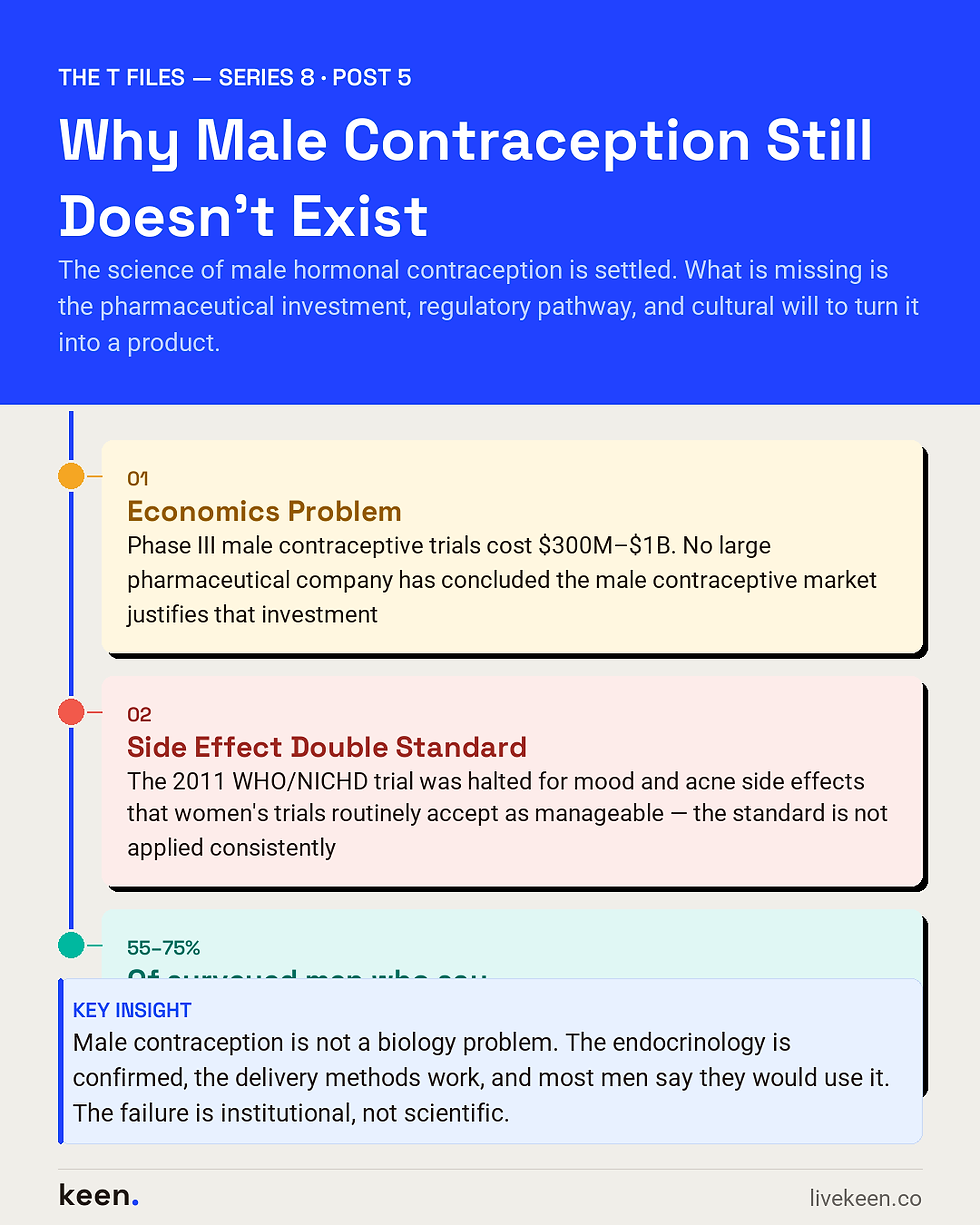
Developing a new contraceptive from Phase II trials through regulatory approval typically costs somewhere between $300 million and $1 billion. The companies that fund drug development at this scale are not charities. They are evaluating whether the investment produces a return.
For male hormonal contraception, the commercial case is genuinely difficult. The market already has effective options that both men and women use: condoms, female hormonal contraception, IUDs, vasectomy. The male contraceptive would need to compete with all of these. It would need to convince men — who currently bear essentially zero pharmaceutical contraceptive burden — to adopt a daily gel or weekly injection as a routine health behavior. It would need to win prescribers, payers, and patients in a category where most of the existing players are either cheap generics or category-dominating female products developed fifty years ago.
The math is not favorable for a $600 million development program.
Public funding has partially compensated for this: the WHO, the National Institutes of Health, USAID, and various foundations have funded much of the key male contraception research precisely because private industry would not. The Population Council — a nonprofit — developed nestorone. But public funding runs out, gets redirected, or gets interrupted by global pandemics. It is not a reliable pipeline for getting a product to market.
The Side Effect Double Standard
The 2011 WHO/NICHD/Conrad injection trial was halted early by a Data Safety Monitoring Board because of adverse events — mood changes, acne, injection site pain, and increased libido — that were deemed unacceptable. The authors of the published trial report noted, somewhat drily, that similar rates of mood-related side effects in female hormonal contraceptive trials are generally not considered grounds for stopping a trial.
This observation was not a minor caveat. It reflected a genuine inconsistency in how risk-benefit calculations are applied to male versus female hormonal contraceptives.
The female pill, introduced in 1960 at doses several times higher than those used today, carried significant thromboembolism risk, depression, and other hormonal effects that were largely minimized in the clinical literature and the cultural narrative for decades. Women were expected to manage these side effects as a condition of reproductive responsibility. The same expectation, applied to men in a controlled trial context, produced a DSMB halt.
Whether this reflects appropriate caution about a new drug class, an asymmetric tolerance for male versus female discomfort, implicit assumptions about who should bear contraceptive burden, or some combination of all three depends on who is doing the analysis. What it does not reflect is a consistent standard across the sexes.
The Cultural Assumptions
Male contraception faces a second, softer barrier: cultural assumptions about male engagement with reproductive health.
The assumption — sometimes stated, often implicit — is that men won’t use it. That men don’t want daily pills or gels. That women can’t trust men to remember. That the burden of contraception belongs to the person for whom an unwanted pregnancy is more consequential.
Survey evidence does not support this assumption. Studies of men’s willingness to use hormonal contraception consistently find majority support — typically 55 to 75% of surveyed men across different populations indicating they would use a safe, effective male contraceptive. The assumption of male disengagement appears to be a cultural projection more than an empirical finding.
But assumptions have power even when they are wrong. They shape investor decisions, regulatory priorities, and marketing feasibility analyses. If pharmaceutical companies believe men won’t use it, they won’t fund it. If they won’t fund it, it won’t exist for men to use. The assumption becomes self-fulfilling.
The Regulatory Uncertainty
Regulatory agencies in the United States and Europe have not established a clear approvability standard for male hormonal contraceptives. The FDA has not issued guidance on what a male contraceptive trial needs to demonstrate — what efficacy threshold is required, what the monitoring requirements are, how long post-discontinuation follow-up needs to run.
This matters because clinical development programs are organized around regulatory endpoints. Without a stated target, sponsors don’t know what they’re aiming for. Without a pathway, investors are funding toward an undefined finish line.
The regulatory gap is not the primary barrier — it would dissolve if a well-funded sponsor came through with a complete clinical package. But it adds friction to a development pathway that already has plenty.
What Would Have to Change
For a male hormonal contraceptive to reach market, several things would need to happen simultaneously:
A sustained funding commitment from public, philanthropic, or private sources capable of carrying a candidate from Phase II through registration — without getting interrupted, redirected, or halted by a DSMB applying asymmetric standards.
A regulatory pathway with clear endpoints, communicated in advance, that allows developers to plan.
A go-to-market strategy that does not assume male non-compliance and instead builds evidence about actual adherence and satisfaction in a real-world context.
A cultural shift, still in early stages, that treats reproductive responsibility as genuinely shared — and that builds the prescriber familiarity, patient demand, and payer support that a new contraceptive category requires.
The Honest Assessment
The male contraceptive is not a pipe dream. The endocrinology works. Multiple Phase II trials have confirmed it. The delivery methods are feasible. The reversibility has been demonstrated.
What does not yet exist is the organized will — institutional, financial, regulatory, and cultural — to take a validated scientific finding through the industrial process that converts a finding into a product.
The history of this research is a history of near-misses. Each one teaches us something. The WHO injections demonstrated that suppression is achievable but highlighted pharmacokinetic problems. DMAU demonstrated oral bioavailability is achievable. The NES/T gel demonstrated that transdermal combination therapy works. Every generation of researchers has moved the science forward.
Eventually, one of these candidates will make it through. The question is not whether the biology supports it. It is whether, at some point, the system that produces medicines decides that reproductive health is not a problem only women should solve.
Sixty years of near-misses suggests the system is not there yet. The science has been ready for a while.
Series 8 Complete. In Series 9, we leave the unfinished story of male contraception and turn to a delivery technology that has already reached market: the transdermal spray platform, what makes it different from gels, and why the pharmacokinetics of spray delivery have changed what testosterone therapy looks like in practice.


